 Poocoin
Poocoin slippage: tolerance limits and minimum received
Updated:Poocoin slippage measures the difference between quoted and executed swap prices, while tolerance sets the output floor checked by the swap method. For a fixed input, a higher tolerance generally lowers the minimum output that the swap must meet. That permits worse execution; it does not improve the pool price or remove a token's transfer fee. Poocoin provides a manual percentage field and an Auto Slippage option in its swap interface. Understanding either choice requires separating the quoted amount, the minimum accepted amount, and the amount actually delivered. Market movement, pool depth, and transfer rules affect those amounts in different ways.
In this guide
Higher tolerance permits a lower output
When the quoted output stays unchanged, increasing tolerance allows the swap to accept a larger shortfall before its output protection stops execution. A percentage therefore describes permission, not the loss that every successful swap will incur. The actual output follows the pool conditions and the applicable token rules when execution occurs. A trade can settle above its minimum, so treating the entire allowance as an automatic deduction misreads the setting. Tightening tolerance raises the acceptance threshold and can cause a swap to fail when the available output falls below that threshold.
Choosing a wider allowance changes the worst acceptable outcome. It leaves the underlying sources of price deterioration in place.
Order size and pool depth determine price impact
If the order is large relative to the pool's liquidity, its own effect on pricing can already make the quote unfavorable before submission. Price impact describes that effect. In a constant-product pool, increasing swap size relative to reserves increases price impact. The quoted output accounts for the pool's pricing calculation across the requested amount. Multiplying a chart price by the input amount can miss that changing price along the trade. A multi-chart comparison supplies market context, while the swap quote prices the requested amount.
A smaller order can reduce this source of deterioration, assuming comparable pool conditions. Raising tolerance cannot produce that improvement because it changes the acceptance limit, not the reserves or order size. Any separate trading fee remains part of the quote's economics.
Minimum received states the output boundary
For an exact-input swap, the minimum accepted output translates price tolerance into a token amount that the router can check during execution. PancakeSwap v2's exact-input router calls carry this amount in
amountOutMin. The quoted output expresses the expected amount under the quoted conditions; the minimum states the lower boundary for the applicable output check. These amounts have the same output-token unit. Their difference helps show the room available for deterioration without treating the minimum as the expected delivery.
The boundary applies to the amount that the selected method measures. Standard pool calculations and balance-based checks for transfer-fee tokens do not necessarily measure the same thing. A token's transfer rules therefore matter when interpreting a displayed receipt estimate. The bound measures tokens, whose later market value can change with their price.
Pool changes before execution move the quote
Other trades or liquidity changes can alter pool reserves between the quote and execution, changing the output available for the same input amount. A waiting transaction has more opportunity to encounter changed conditions, although elapsed time does not determine a fixed loss. A refreshed preview reflects the newly quoted state. It does not rewrite the parameters already signed into a pending transaction. Comparing an earlier quote with a later preview therefore reveals changed expectations, not the final amount that the swap delivered.
Manual tolerance and Auto Slippage make different selections
Manual entry uses the percentage that you choose, while Poocoin's Auto Slippage option selects a percentage for the trade. That choice affects output flexibility. Manual control is useful when the acceptable shortfall is already clear. Automatic selection addresses the choice of a workable tolerance, including trades affected by token transfer mechanics. In either case, the selected allowance needs to fit the output that you are willing to accept. A setting that enables execution can still permit an economically unfavorable trade.
The pool selector's Auto option chooses the pool used for the trade. A different pool can change the quote through its reserves and trading conditions. Auto Slippage governs the allowance around a quote.
A wide allowance can also leave more room for a sandwich attack. In such an attack, another trader places transactions around a pending swap to move its execution price and capture the difference. The affected swap can still meet its minimum-output condition. Output protection limits the permitted deterioration; transaction ordering can exploit movement that remains inside that limit.
How can I calculate the output shortfall?
If the quote and receipt describe the same input, output token, and accounting basis, subtract the received amount from the quoted amount to calculate the shortfall. Let
Q
represent quoted output and
R
represent the comparable received output. The shortfall is
Q - R
in output tokens. Its percentage is
100 × (Q - R) / Q, provided that
Q
is positive.
With
M
representing the applicable minimum output,
100 × (Q - M) / Q
expresses the output gap between quote and floor. This calculation describes those amounts; the percentage field's conversion convention determines how the interface obtains its minimum. Token precision and rounding also affect displayed amounts. The router enforces its encoded amount, not a percentage reconstructed from rounded screen values.
A gross pool output and a receipt after transfer fees use different accounting bases. Their gap cannot establish market slippage alone.
Transfer fees change the amount that reaches the recipient
When a token deducts a fee during transfer, the amount that reaches a pool or wallet can differ from the nominal amount sent. That deduction comes from the token's rules. It can contribute to a shortfall even when the pool price barely changes. Increasing tolerance accommodates a larger shortfall where the selected swap method supports those rules; it does not remove the deduction.
Fees on the input transfer
A fee on the input token can leave the pool receiving less than the requested input amount. PancakeSwap v2's fee-supporting methods calculate the swap using the input that actually reaches the pool. A method that assumes the full amount arrived may fail when that assumption breaks.
Checks on the output amount
Standard exact-input methods
Standard PancakeSwap v2 exact-input methods compare the calculated final pool output with
amountOutMin. If the output token then deducts a transfer fee, the recipient's credited amount can be lower than that calculated output. A pool-output bound alone does not establish the wallet's receipt after token deductions.
Fee-supporting methods with token output
PancakeSwap v2's fee-supporting token-output methods check the recipient's token balance increase against
amountOutMin.
That check accounts for the amount credited during the swap. It applies to these token-output methods, not every possible router call. Contract restrictions or incompatible transfer behavior can still prevent execution even with a permissive minimum.
Failure messages distinguish the stopping condition
An output error calls for examining the amount available against the required minimum; approval, funding, and expiry errors concern different requirements.
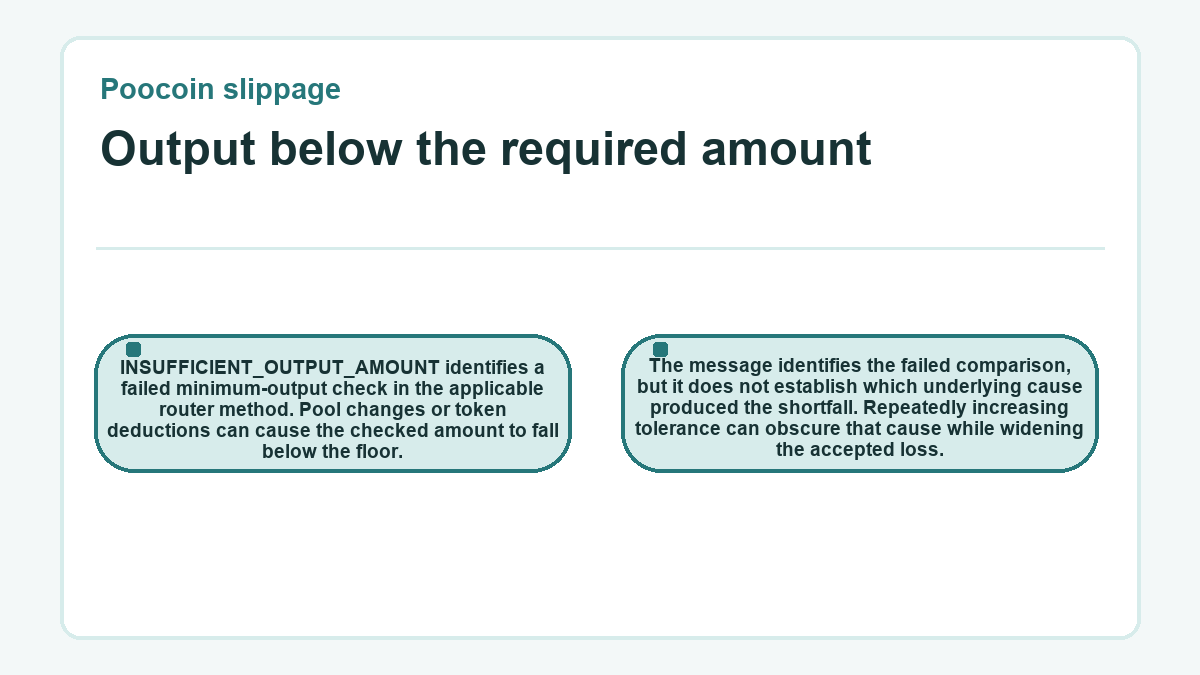
Output below the required amount
INSUFFICIENT_OUTPUT_AMOUNT
identifies a failed minimum-output check in the applicable router method. Pool changes or token deductions can cause the checked amount to fall below the floor. The message identifies the failed comparison, but it does not establish which underlying cause produced the shortfall. Repeatedly increasing tolerance can obscure that cause while widening the accepted loss.
Requirements outside price tolerance
An insufficient allowance concerns permission to spend the input token. Insufficient gas funds concern payment for network execution. An expired deadline means the transaction has passed its permitted execution time. Changing the output allowance does not satisfy any of those separate requirements. A gas-estimation failure can also signal a contract rejection before submission.
A rejected wallet prompt or failed estimate differs from a transaction included on-chain and then reverted. A reverted swap on BNB Smart Chain still incurs a network fee for the gas it used when its effective gas price is nonzero. The reverted swap does not complete its token exchange, while an earlier successful approval remains a separate transaction.
A token that blocks the relevant transfer or sale cannot be made tradable merely by lowering its required output.
Choosing tolerance from the output you can accept
When reconciling a quote with an observed shortfall, compare what order size changes with what a tolerance adjustment permits. A smaller order can improve a liquidity-sensitive quote. A wider tolerance permits more deterioration from the quote used for that swap. Token deductions require their own accounting.
- If the quote already shows substantial price impact, consider the order's size relative to available liquidity before widening tolerance.
- If the quote changes while the transaction waits, distinguish that movement from the price impact already included in the initial estimate.
- If a token deducts transfer fees, establish whether the relevant output check measures pool output or tokens credited to the recipient.
- If the error concerns allowance, gas funds, or expiry, address that requirement before changing the output limit.
- If the minimum output would be unacceptable, avoid authorizing that floor merely to clear an execution error.
A tighter floor preserves a narrower acceptance range and can reject more swaps under changing conditions. A wider tolerance can clear an output-related obstacle while allowing a worse receipt. The next choice is whether the quoted trade and its minimum both remain acceptable, or whether the amount or trading conditions need to change.
Poocoin slippage: common questions
Can I receive more tokens than the quote?
An exact-input swap can deliver more than quoted if execution conditions improve and its method imposes only a minimum-output bound. The minimum sets a lower threshold for the applicable check, rather than capping favorable output. Token transfer deductions can still affect the amount that reaches the recipient, so compare amounts on the same basis.
Is Auto Slippage a form of transaction privacy?
Automatic slippage selection does not make a publicly broadcast swap private. Tolerance governs acceptable execution, while the submission path determines how pending transaction details become visible. Other traders can use visible swaps when planning transaction ordering. Automatic percentage selection alone does not establish protection against a sandwich attack.
Are the same tolerance settings suitable for buying and selling a token?
Buying and selling need separate assessments because the input, output, and applicable transfer rules can differ by direction. Liquidity conditions also determine the quote for each trade. A percentage that allowed a purchase does not prove that a sale will meet its output requirement or pass the token contract's restrictions.
Could a lower wallet fiat value prove that slippage exceeded my limit?
A lower displayed fiat value alone cannot establish a violation of a token-output limit. Wallet valuation also reflects the conversion price used to value the tokens. The relevant comparison uses the output amount checked by the swap method and its encoded minimum. Network fees and later price movement affect value separately.